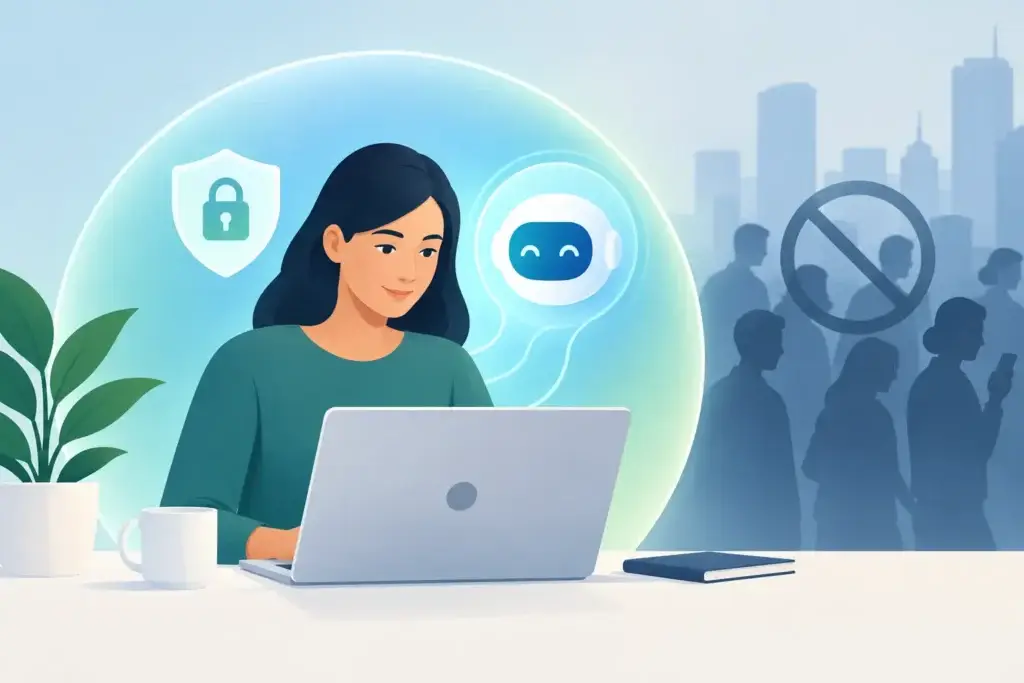
At 1:17 a.m., when your mind is replaying a hard conversation or turning a decision over for the tenth time, privacy is not an abstract feature. It is the difference between speaking freely and holding back. The future of private AI will be shaped by that moment: whether people can ask for support, organize their lives, and be honest about what they feel without wondering who else may be listening.
For years, the default model of consumer technology has been simple: give people a useful service, collect their behavior, and turn that behavior into a business asset. AI makes that arrangement far more personal. A companion that remembers your routines, fears, relationships, health concerns, financial pressures, and private thoughts can be genuinely helpful. It can also create a record of a life that no person should have to surrender just to receive support.
The Future of Private AI Is a Question of Trust
The next generation of AI will not be judged only by how clever its answers sound. It will be judged by whether it deserves access to the details behind those answers. People do not need another system that treats a vulnerable conversation as material to retain, analyze, share, or use to build a profile.
Private AI starts from a different belief: your conversation belongs to you. Your memories, preferences, notes, and patterns should serve your life, not a company’s advertising strategy, data partnerships, or future product experiments. That is not a nice extra for people who happen to be cautious. It is the foundation required for a real relationship with a personal AI.
There is a difference between an assistant that knows your calendar and a companion that understands why an appointment is weighing on you. The second kind of support requires context. Context can make AI calmer, more useful, and more consistent over time. But context without meaningful control can become surveillance with a friendly voice.
Memory Should Be Earned, Visible, and Removable
Long-term memory is one of AI’s most promising abilities. A companion that remembers you prefer voice notes after a draining day, that you are preparing for a difficult family visit, or that you wanted to revisit a decision on Friday does not make you repeat yourself from scratch. It can offer continuity when life feels scattered.
Still, memory must not become a trap. A private AI should make it clear what it remembers, give you a way to manage it, and let you remove it. There are thoughts people want to say once and leave behind. There are seasons of life they may not want permanently attached to a profile. The right to delete should be practical, not buried behind a support request or vague promise.
The same principle applies to personalization. A companion should adapt to your needs without pretending to own a permanent version of you. People change jobs, relationships, routines, beliefs, and boundaries. A helpful AI makes room for that change.
Privacy Must Be Built Into the Product
A privacy policy cannot repair an architecture designed around extraction. If deeply personal conversations are routinely stored on remote servers, copied into backups, retained for long periods, or accessible through broad internal systems, the user has already lost much of the control that a reassuring policy may describe.
The strongest privacy protections happen before data leaves a person’s phone. Local device storage keeps sensitive context close to the person it belongs to. Biometric access controls and voice recognition can add another layer of protection when a phone is shared, misplaced, or left within reach of someone else. These details matter because private support is only private if the device experience respects it too.
That does not mean every private AI feature can work entirely offline. Web search needs an internet connection. Calendar and contact integrations involve permissions. Safety features that notify trusted people depend on cellular service, operating system behavior, and the contacts a user chooses. The honest standard is not pretending that every feature is invisible to the outside world. It is being specific about what leaves the device, why it leaves, and what control the user has.
Convenience Has a Cost – and People Deserve a Choice
Cloud-based AI can offer advantages. It may make it easier to use powerful models, sync across devices, recover an account after a lost phone, or process demanding tasks. For some people, those conveniences are worth the trade-off.
But the trade-off should be real and clearly stated. “Private” cannot mean that conversations are still broadly retained somewhere else, with the user expected to trust an unseen chain of vendors and policies. Nor should people have to choose between a useful companion and basic dignity.
The future will likely include different privacy models, from fully local experiences to carefully limited cloud features. What matters is choice without pressure. A person should be able to understand the difference before sharing the kind of information they would never post publicly.
Emotionally Intelligent Does Not Mean Performatively Agreeable
As AI becomes more conversational, there will be a temptation to confuse warmth with constant validation. A companion that agrees with everything may feel pleasant for a moment, but it is not always helpful. When someone is overwhelmed, stuck in a pattern, or avoiding a difficult decision, empty reassurance can leave them more alone than an honest response would.
A better personal AI listens without judgment, responds with care, and remains grounded. It can help a person name what is happening, sort one problem from another, remember their own stated priorities, or take the next manageable step. It should not claim to replace a trusted person, a professional, emergency services, or the fuller support that certain situations require.
Privacy makes this kind of honesty possible. People are more likely to speak plainly when they do not feel observed. They can say, “I am not handling this well,” or “I do not know what I want,” without turning a difficult moment into another data point in a commercial system.
The Personal AI People Keep Will Respect Boundaries
The most lasting AI products will not necessarily be the loudest or most human-like. They will be the ones that understand limits. A good companion knows when to offer a reminder, when to ask a thoughtful question, and when to simply make space. It does not manufacture urgency to increase engagement. It does not make loneliness more profitable. It does not turn trust into dependency.
That requires designers to measure success differently. Daily use can be meaningful, but it is not the only measure of care. So is whether people feel more organized, more steady, more able to follow through, and more comfortable being themselves. So is whether they can leave a conversation knowing that it remains theirs alone.
For MyPal, that conviction is reflected in local device storage, user-managed memories, and a simple promise: personal support should not require personal surveillance. The technology will keep changing. The principle should not.
What to Expect Next From Private AI
Expect more AI to move closer to the device, where personal context can be stored and used with less exposure. Expect stronger biometric protections, clearer memory controls, and more tools that let people decide exactly what a companion may access. Voice-first interaction will also become more natural, especially for people who need a quiet place to think while walking, driving, or trying to fall asleep.
There will be pressure in the other direction, too. Companies will continue to argue that more collection creates better personalization. Sometimes it may. But a better answer is not always an answer worth giving if it comes at the cost of a person’s private life. A system can be capable and still be too intrusive.
The people who shape the future of private AI will have to make difficult design choices: when to keep data local, how to explain permissions, how to handle safety concerns responsibly, and how to make privacy understandable without making users feel like security experts. Those choices should be guided by a plain question: if this were your most personal conversation, would this be enough protection?
The best personal AI will not ask people to become less human in order to use it. It will give them a place to be candid, forgetful, uncertain, hopeful, and still in control. That is the future worth expecting from something invited into the quietest parts of a life.