
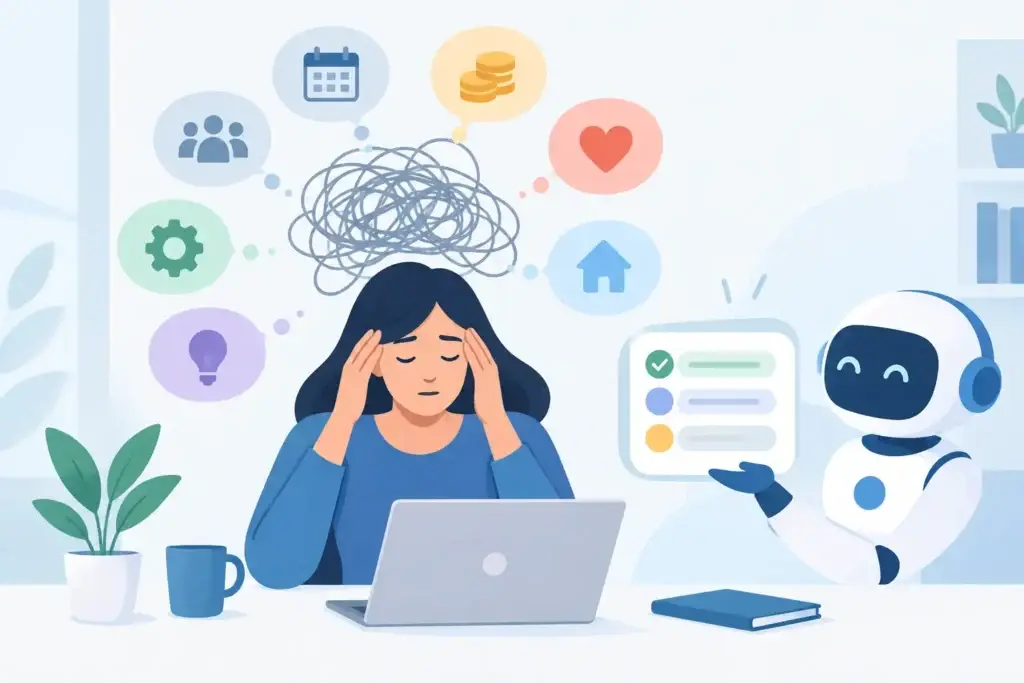
Some decisions look small from the outside: whether to take the job, send the text, move closer to family, set a boundary, or spend money you are not sure you have. But when you are tired, lonely, stressed, or carrying ten unfinished worries at once, even a simple choice can feel like a verdict on your whole life.
AI help with decisions is not about handing your life over to a machine. At its best, it gives you a private place to slow down, say what is actually on your mind, and hear your own thinking more clearly. The goal is not for AI to choose for you. The goal is to make it easier for you to choose with more honesty, context, and calm.
Why decisions feel harder than they should
Decision fatigue is real in a very ordinary way. Every day asks you to make dozens of calls: what needs attention now, what can wait, who needs a reply, what you can afford, and how much energy you have left. By the time a meaningful decision arrives, you may not lack intelligence or information. You may simply lack room to think.
There is also the emotional layer. A choice can bring up guilt, fear of disappointing someone, old regrets, or the pressure to get everything right. Friends can be helpful, but they may have their own opinions or stakes in the outcome. Searching online can produce more advice than clarity. And keeping it all inside usually makes the decision louder, not clearer.
A steady conversational companion can interrupt that spiral. It can ask, “What part of this feels most urgent?” or “What are you afraid will happen if you choose either option?” Those are not magic questions. They are useful because they move the decision out of the fog and into words.
What good AI help with decisions actually does
Helpful AI does not pretend there is one perfect answer waiting to be calculated. Most personal decisions involve competing values. The promotion may offer security but cost you time. Staying may feel familiar but keep you stuck. Saying yes may protect a relationship today while ignoring what you need tomorrow.
A good conversation makes those trade-offs visible. It helps separate facts from predictions, preferences from obligations, and a temporary feeling from a lasting priority. If you are deciding whether to leave a difficult job, for example, it can help you lay out what is happening now, what would need to change for you to stay, what practical constraints exist, and what a realistic transition could look like.
That is different from asking an AI, “What should I do?” and accepting the first answer. A thoughtful companion should help you examine the question beneath the question. Are you looking for permission? Reassurance? A plan? A way to avoid a hard conversation? Knowing that changes what support is useful.
Start with the real decision
Many choices arrive disguised as a single yes-or-no question. “Should I move?” may really mean, “Can I bear being this isolated for another year?” “Should I end this relationship?” may mean, “Have I been shrinking myself to keep the peace?”
Try stating the decision in one plain sentence, then add what makes it hard. For example: “I am deciding whether to accept this role because I need the money, but I am worried the workload will damage my health.” That sentence gives the conversation something honest to work with.
Make room for both logic and feeling
A list of pros and cons can help, but it is not always enough. Two options may have the same number of advantages while carrying very different emotional weight. If you write “more time with family” beside “lower salary,” the list does not tell you which cost you can live with.
Talk through both sides. Ask what each option would look like on an ordinary Tuesday six months from now. Ask which regret feels more likely: trying and failing, or never trying at all. Then check your answer against practical reality. Feelings deserve attention, but they should not force you to ignore rent, safety, caregiving, contracts, or your physical limits.
Turn a huge choice into a next step
Not every decision needs to be final today. Sometimes the most honest answer is that you need more information, more rest, or one difficult conversation before you can decide.
AI can help turn a broad worry into a manageable action. Rather than deciding immediately whether to change careers, you might update your resume, price out a certification, or speak to one person doing the work you are considering. Rather than deciding whether a friendship is over, you might name one boundary and see how it is received. A next step is not avoidance when it reduces uncertainty in a meaningful way.
Privacy changes the quality of the conversation
People make better use of reflection when they are not editing themselves for an audience. If you are weighing a relationship, money concern, family conflict, health worry, or workplace issue, privacy is not a nice extra. It is part of what allows you to be candid.
Be careful about where intimate decision-making conversations live. Before sharing, understand whether your words are stored on company servers, used to improve systems, connected to an advertising profile, or easy for someone else with access to your device to find. Convenience should not require you to surrender the most personal parts of your life.
MyPal was built around a different promise: your conversations are yours alone. With local device storage, user-managed memories, and biometric access controls, it is designed to offer a personal space for ongoing reflection without treating your private life as data to be sold. That matters especially when the decision is not a one-time question, but part of a longer story only you fully understand.
Long-term context can be useful when it remains under your control. A companion that knows you are trying to spend less, recover your sleep routine, prepare for a move, or hold a boundary can help you notice patterns over time. But you should always be able to review or delete what is remembered. Support should never come at the cost of ownership.
Where AI should not be the final voice
AI can help you organize thoughts, rehearse a conversation, identify questions, and create a plan. It cannot live with the consequences of your choice. It does not know every detail, and it can misunderstand, overgeneralize, or sound more certain than it should.
For legal, medical, financial, or safety-critical decisions, use qualified human support as well. If you feel in immediate danger or at risk of harming yourself or someone else, contact emergency services or a crisis resource in your area. A private companion can be a source of steady support, but it is not emergency response, professional care, or a substitute for people equipped to act.
There are decisions where the healthiest move is to bring another person in, even if that feels uncomfortable. A trusted friend, attorney, doctor, financial professional, manager, or counselor may see risks and options that a conversation alone cannot resolve. AI can help you prepare what to say before you reach out.
A simple way to use AI without giving away your agency
Bring one decision at a time. Describe the facts, then say what you want, what you fear, and what feels nonnegotiable. Ask for questions before recommendations. Ask it to challenge assumptions gently, point out missing information, and help you compare realistic paths.
If you notice yourself asking the same question repeatedly, pause. You may not need another answer. You may need reassurance, permission to grieve, or a small action that moves you from thinking to living. That is a useful thing to recognize, not a failure.
The right decision is rarely the one that removes every uncertainty. Often, it is the one you can make honestly, with your eyes open, while staying connected to what matters to you. Give yourself a private place to hear that voice. Then let the choice remain yours.