
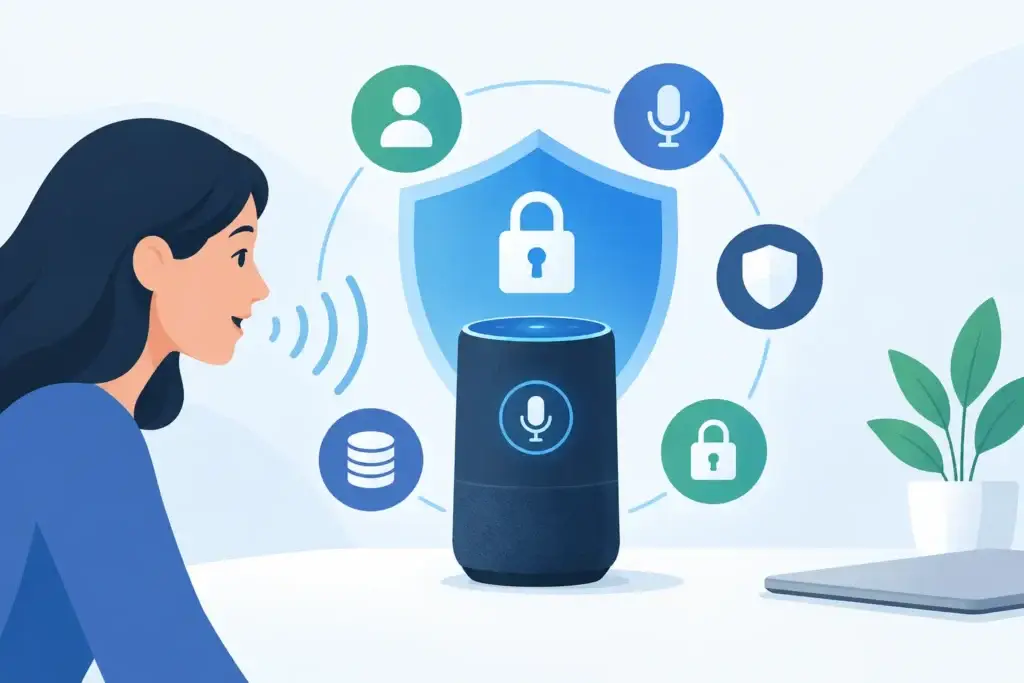
Some thoughts do not arrive neatly enough to type. They show up while you are driving home after a hard conversation, lying awake at 2 a.m., or trying to decide whether your worry is reasonable. A voice first AI assistant gives those moments somewhere to go: a calm presence that can listen when opening a keyboard feels like one more thing to manage.
But voice is not just a convenient interface. When someone speaks about a relationship, a fear, a money decision, or a lonely evening, they are often sharing more than they would put into a search bar. That changes the standard. A helpful companion should be easy to talk to, honest in its responses, and built to protect what it hears.
Why voice changes the kind of support people need
Typing asks you to edit yourself. You choose the right words, delete the messy parts, and often stop before you say what you meant. Speaking can be more immediate. You can pause, change your mind, ramble a little, and work through a thought in real time.
That is especially useful when your hands are full or your mind is tired. A voice conversation can help you talk through tomorrow’s priorities while making coffee, capture a reminder before you forget it, or sort through a difficult feeling without turning it into a polished explanation.
Still, voice is not automatically better. Some people process more clearly in writing. Others live with roommates, family members, or coworkers nearby and want quiet. A companion worth keeping should respect both modes. Voice should be available when it feels natural, not forced on people who need the privacy and control of text.
A voice first AI assistant is more than a speaker
Many assistants are built around commands: set a timer, play music, tell me the weather. Those tasks matter, but they are not the whole reason people seek a consistent AI presence.
A personal companion needs to understand the difference between a request and a moment of uncertainty. “Remind me to call my sister” is a task. “I have not called my sister because I am still hurt” is an opening. The right response is not blind agreement, fake cheerfulness, or a quick attempt to solve everything. It is thoughtful conversation that helps you name what is happening and decide what you want to do next.
That means constructive honesty matters. A companion should not flatter you into a worse decision simply because agreement feels nice. It can be kind while asking a useful question, noticing a pattern you have shared, or offering a practical next step. Presence without judgment does not mean presence without standards.
The relationship also becomes more useful over time. If you have mentioned that mornings are difficult, that a certain family situation is ongoing, or that you prefer direct advice over vague reassurance, you should not need to start from zero every time. Memory can make conversation feel continuous instead of transactional.
Memory should belong to the person sharing it
Long-term memory is powerful because life is not a series of isolated prompts. Your preferences, routines, goals, and unresolved concerns provide context. Used well, memory lets a companion ask better questions and offer help that fits your actual life.
Used carelessly, it becomes something else: a record of your private life held somewhere you cannot see, control, or fully take back. That is not a small trade-off. For many people, the hardest part of speaking honestly is wondering where those words will end up.
A trustworthy voice first AI assistant should make memory understandable and controllable. You should know what is being remembered, be able to change or delete it, and have a clear choice about what stays. Privacy cannot be a vague promise buried behind settings. It should shape the product from the beginning.
MyPal approaches this with user-managed memory and local device storage rather than treating intimate conversations as material for a distant data warehouse. Your conversations are yours alone. That principle matters whether you are discussing a grocery list or something you have never said out loud to anyone else.
Privacy is the condition for candor
People often accept surveillance as the price of convenience because they feel they have no real alternative. But a companion designed for emotional reflection should not ask you to make that bargain.
When a service sells behavioral data, builds advertising profiles, or keeps deeply personal conversation histories on company servers, it creates a conflict between your need for a safe outlet and its need to extract value from what you share. You may still receive useful answers, but the relationship is no longer centered on you.
Privacy is not merely about avoiding embarrassment. It is about dignity. It is the freedom to say, “I am scared,” “I am angry,” or “I do not know what to do,” without wondering whether your words will be used to target you, train a profile about you, or become accessible beyond your control.
Practical protections matter here. Local storage, biometric access controls, and clear deletion options are not glamorous features, but they make private use more realistic. The right details depend on your phone and your habits. If someone else can regularly access your unlocked device, no app can create perfect privacy. Still, a product should reduce exposure rather than normalize it.
The best help moves between feelings and real life
Emotional support and everyday organization are often treated as separate categories. Real life does not work that way. Anxiety about an appointment may mean you need to talk through it, write down the questions you want to ask, and set a reminder so you do not avoid it. Decision fatigue may call for a listening ear first, then a short list of next actions.
That is where a companion can be genuinely useful. It can hold a thought, help organize a plan, keep a note, or remind you of something important without forcing you to switch into a dozen different tools. The purpose is not to turn every feeling into a productivity project. Sometimes the right help is simply being heard. Other times, a small practical step makes a difficult moment less heavy.
The balance matters. Constant notifications can create pressure instead of relief. Too much automation can make a companion feel impersonal. Helpful support is configurable, quiet when you need space, and available when you ask for it.
Safety tools need clear limits
For some people, a personal companion also has a role in practical safety. A discreet tool that can notify trusted contacts and share location may offer reassurance during a walk, a ride home, or an uneasy situation. It can be a meaningful part of a personal safety plan.
It must never be presented as a guarantee. Location messaging depends on a working phone, available battery, permissions, and cell service. Features can also operate differently on Android and iPhone. No app can replace emergency services, situational awareness, or contacting 911 when there is immediate danger.
Clear limits are not a weakness. They are how trust is earned. People deserve to know what a safety feature can do, what it cannot do, and what conditions it needs before they rely on it.
Choose the companion that earns your voice
Before you make an AI companion part of your daily life, ask a few plain questions. Can you use it by voice and text? Does it remember context only in ways you can manage? Where does your private information live? Can you delete it? Is the company direct about its limits, pricing, and data practices?
Convenience is easy to promise. Trust is harder. A voice first AI assistant should feel like a steady place to bring the unfinished parts of your day, not another system asking you to give up more than you intended.
The next time your mind starts circling the same thought, try saying it plainly. You do not need to have the perfect words before you deserve a place to begin.